As an Amazon Associate, we earn from qualifying purchases. Some links on this site are affiliate links at no extra cost to you. Our recommendations are based on thorough research and editorial judgment.

Push-Pull-Legs Split Using Only Dumbbells and Benches

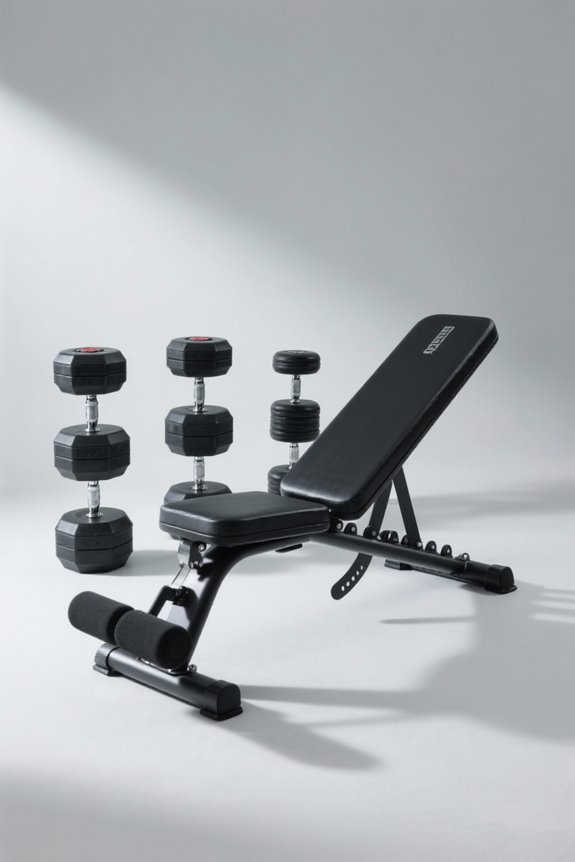
We can optimize our Push-Pull-Legs split using just dumbbells and benches for effective muscle targeting and balanced development. Dumbbells allow for versatile angles and weight adjustments, promoting symmetrical growth and neuromuscular coordination. Benches enhance workouts by enabling different incline and decline movements, improving muscle activation. Our workouts can be tailored for beginner to advanced levels, incorporating progressive overload strategies like increasing reps or weight. If you’re seeking effective routines, we’re sure you’ll find this approach beneficial.
Key Takeaways
- Design workouts using push, pull, and legs exercises with dumbbells and benches for targeted muscle activation and variety.
- Focus on compound and isolation movements like dumbbell presses and rows, incorporating bench angles for diverse muscle engagement.
- Implement progressive overload through weight increments or additional reps, ensuring balanced muscle gains and strength improvement.
- Customize training frequency from 3 to 6 days weekly, aligning with individual recovery needs for optimal muscle development.
- Prioritize safety with proper warm-up routines, load management, and equipment checks to prevent injuries during workouts.
Understanding the Basics of PPL Split
When it comes to understanding the Push-Pull-Legs (PPL) split, we’re diving into a workout routine that’s as structured as it is effective. This split divides exercises into Push, Pull, and Legs, each targeting specific muscle groups. PPL variations allow us to customize our workouts, ensuring muscle balancing and addressing individual needs. With options to train 3 to 6 days a week, we can tailor our schedule for optimal muscle recovery.
Incorporating compound and isolation exercises, PPL enhances efficiency by focusing on muscle groups that work together naturally. We can adjust the frequency and type of exercises to suit our fitness levels. By maintaining a balance between recovery and training, PPL offers a flexible approach to achieving our fitness goals. For home gym setups with limited space, adjustable dumbbells provide the versatility needed to perform the full range of push, pull, and leg exercises while occupying minimal storage area.
Advantages of Using Dumbbells in PPL Workouts
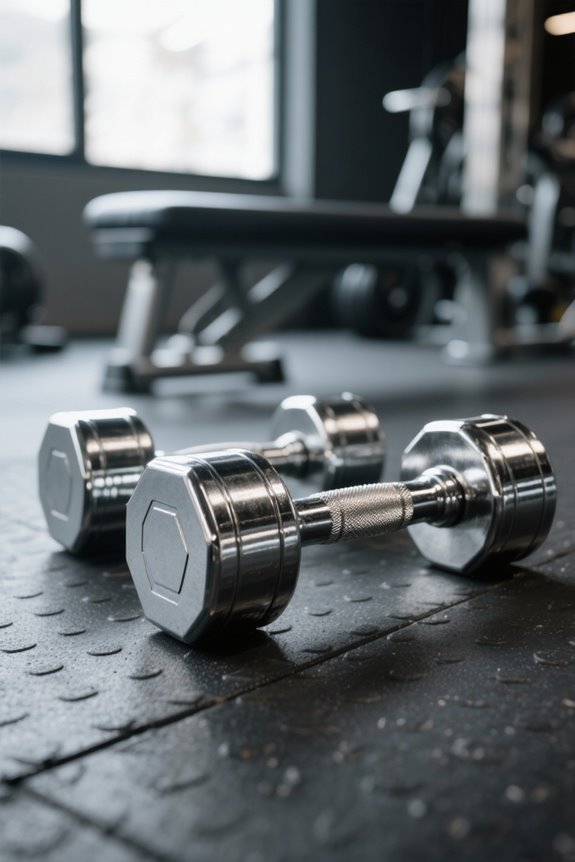
Let’s dive into the many advantages of using dumbbells in our Push-Pull-Legs (PPL) workouts. Dumbbell versatility makes them a staple in any routine, allowing us to adjust weights and angles easily, enhancing workout adaptability. By demanding muscle stabilization and balance improvement, dumbbells engage more muscle fibers, promoting symmetrical muscle development and reducing dominance compensation. They also support joint safety, following natural movement patterns and preventing injury. We enjoy enhanced neuromuscular coordination, which boosts functional training and efficiency. This adaptability ensures that our exercises remain effective across all fitness levels. Plus, dumbbells help prevent injury by allowing us to train within pain-free ranges. The hexagonal shape of rubber hex dumbbells prevents rolling during workouts, providing additional stability and safety during your training sessions. Together, these benefits highlight why dumbbells are invaluable in a PPL workout regime.
Recommended Products

Home Gym Equipment Weight Set:Includes 5, 10, 15, 20, 25, 30, 35, 40, 45, 50, 55, 60, 65, 70, 75, 80, 85, 90, 95, and 100lb dumbbell pairs, (2) of 3-tier racks and (2) of mats. You can use these solid dumbbells in a wide range of exercises, also a perfect choice for both beginners or athletes.

Premium Dumbbell + Rack Bundle: Get a complete strength training solution with REP Fitness rubber hex dumbbells and a sleek, durable 3-tier storage rack – built for both commercial and home gym setups.

💪 Complete Dumbbell Set – Includes 5, 10, 15, 20, 25, 30, 35, 40, 45, 50, 55, 60, 65, 70, 75, 80, 85, 90, 95, and 100 lb dumbbell pairs. DUMBBELLS ONLY! Perfect for a wide range of exercises for beginners and athletes.
Benefits of Incorporating Benches in PPL Routines
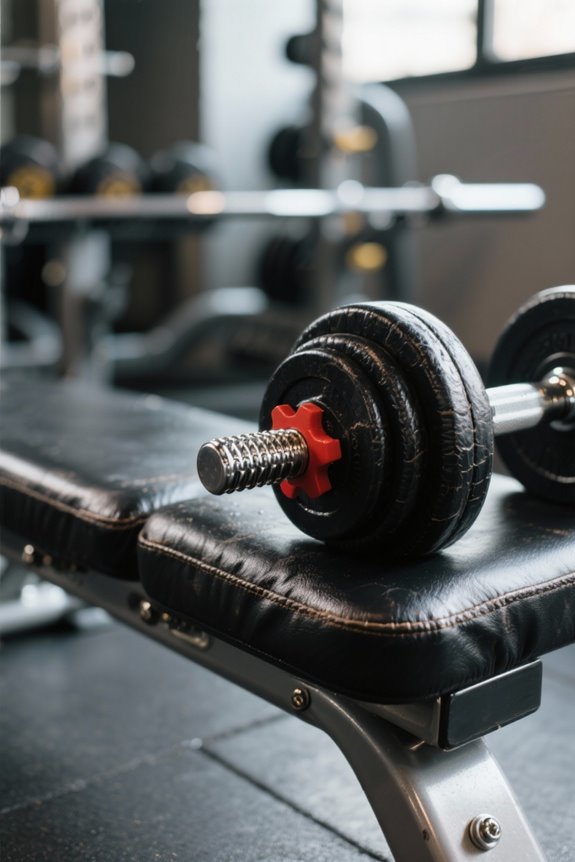
Incorporating benches into our Push-Pull-Legs routines offers a multitude of benefits that can significantly enhance our workouts. By using benches, we can better target specific muscles, ensuring efficient and effective muscle engagement. This precision allows us to focus on various muscle groups, promoting balanced growth and improved muscle hypertrophy. Additionally, benches introduce workout variety; exercises like incline, flat, and decline bench presses engage different areas of the chest, while bench dips and step-ups diversify our routines. Not only do they prevent injuries by supporting our backs during heavy lifts, but they also improve stability and form, crucial for beginners. Benches streamline our training sessions, allowing us to modify workouts easily and adapt them to our fitness levels, enhancing overall efficiency. For serious lifters, selecting benches with heavy-duty steel frames can support substantial weight loads, with some models accommodating up to 1,300 lbs for advanced training sessions.
Recommended Products

Patented Smith Bar & Weight Multiplier System - Selectorized smith bar with weight stack system that multiplies resistance up to 330 lb. No need for a spotter or olympic weight plates.

Upgraded Speediance Gym Monster: Strength Training, Now at a New Level! Featuring a powerful 2.1-channel speaker, 11 adjustable height levels, AeroRow Rowing Bench, a state-of-the-art cooling system, and an upgraded screen chip, this all-in-one gym immerses you in your workouts, ensuring each session is both engaging and effective

Freight Delivery: You must provide an accurate phone number and delivery address on the order so the freight carrier can contact you to schedule the delivery.
Designing a Push Day Workout With Dumbbells and Bench
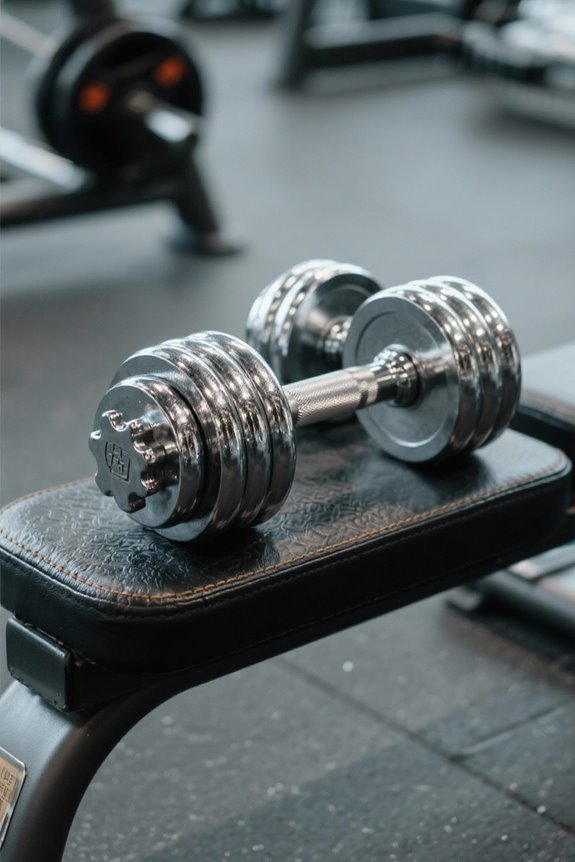
Designing a push day workout with dumbbells and a bench requires thoughtful exercise selection to target all the key muscles involved in pressing movements. We should focus on exercise variations, like the dumbbell bench press, which primarily targets the chest, shoulders, and triceps, providing excellent muscle activation. The overhead dumbbell press emphasizes shoulders and triceps, enhancing strength and supporting pressing motions. For variety, incorporating dumbbell floor presses can be effective when a bench isn’t available, engaging similar muscles. Single-arm dumbbell bench presses increase core activation and improve unilateral strength balance. To maximize effectiveness, maintain controlled lowering during exercises and engage the core for stability. By progressively overloading with heavier dumbbells or more reps, we’ll achieve balanced hypertrophy and strength gains. For home gym setups, adjustable dumbbells offer the versatility to progress from lighter weights like 5 lbs up to heavier loads of 50-90 lbs, allowing continuous progression without requiring multiple fixed-weight sets.
Recommended Products
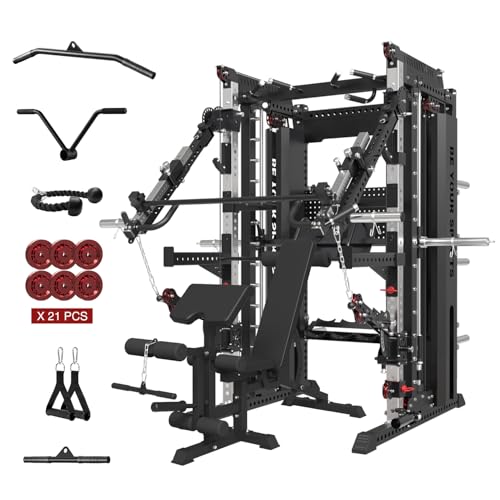
Professional Commercial Smithe Machine: The Smithe Machine with Cable Crossover and Leg Attachment is made of 3”x3” industrial steel and reinforced joints for 3600lb capacity. Overall dimensions are 49"L x 64"W x 89"H with multiple 1'' holes. Heavy-duty base stabilizers prevent wobble during kipping pull-ups, while rubberized floor protectors safeguard hardwood surfaces—ideal for basement gyms or garage workout areas.

INDUSTRY LEADER: For 30+ years, Best Solid has held the widest array of products designed to meet the demands of the ever-changing fitness industry (home gym, free weight machines, treadmills, bikes, ellipticals, weight plates, kettlebells, dumbbells, flooring, accessories and more). Our products are cutting edge and reliable and are built for LifeYour Life.

What's Included: 5, 10, 15, 20, 25, 30, 35, 40, 45, 50, 55, 60, 65, 70, 75 lb pairs of urethane coated dumbbells
Crafting an Effective Pull Day Routine With Dumbbells and Bench

When crafting an effective pull day routine with dumbbells and a bench, we should focus on exercises that maximize muscle engagement across the back and biceps, using a mix of compound and isolation movements. Start with compound exercises like dumbbell deadlifts and bent-over rows to utilize our energy and strength early, promoting effective muscle engagement. Follow these with isolation movements such as alternating dumbbell bicep curls to refine muscle definition. Incorporating single-arm dumbbell rows on the bench helps correct imbalances, enhancing core stability. Aim for a balanced workout structure by using 3–4 sets per exercise, with rep ranges of 8-12 for strength or 12-15 for hypertrophy. Rest intervals between 60-90 seconds ensure we maintain intensity while allowing recovery. For home gym setups, consider investing in adjustable dumbbells that can accommodate weight ranges up to 90 lbs, allowing for progressive overload as your strength increases across all pulling movements.
Recommended Products

What you will get: Two adjustable dumbbell 90lbs(80lbs with 10lb additional plates) and One Upgrade 4in1 Weight Bench. They will be shipped out in three separate packages.

Heavy Duty Dumbbell Set with Rack: Our complete home gym package pairs durable rubber hex dumbbells with a robust 3-tier steel rack. This all-in-one set is designed for efficient strength training and full-body workouts.

What you will get: Two 80 lb adjustable dumbbells and One dumbbell rack. Shipped out in three separate packages.
Building a Comprehensive Leg Day Using Dumbbells and Bench
A well-rounded leg day routine with dumbbells and a bench can transform our lower body strength and aesthetics. Let’s focus on key exercises for optimal dumbbell leg development. Bulgarian split squats, with our rear foot elevated on the bench, enhance single-leg strength and balance, targeting quads and glutes effectively. Step-ups drive quad strength, emphasizing unilateral work crucial for balanced muscle growth. Dumbbell goblet squats, using the bench as a depth guide, ensure deep squat execution, engaging both quads and glutes. For glute development, bench-supported hip thrusters excel, offering focused hip extension strength. Lastly, calf raises using the bench edge build lower leg endurance. By structuring our workouts with these bench squat variations, we achieve comprehensive leg conditioning. Adding flexibility bands to these exercises can provide variable resistance and help activate muscles during warm-up phases.
Recommended Products
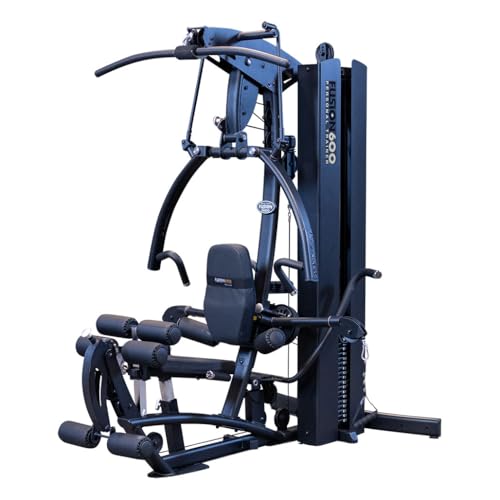
"INDUSTRY LEADER: For 30+ years, Body Solid has held the widest array of products designed to meet the demands of the ever-changing fitness industry (home gym, free weight machines, treadmills, bikes, ellipticals, weight plates, kettlebells, dumbbells, flooring, accessories and more). Our products are cutting edge and reliable and are built for Life……Your Life."
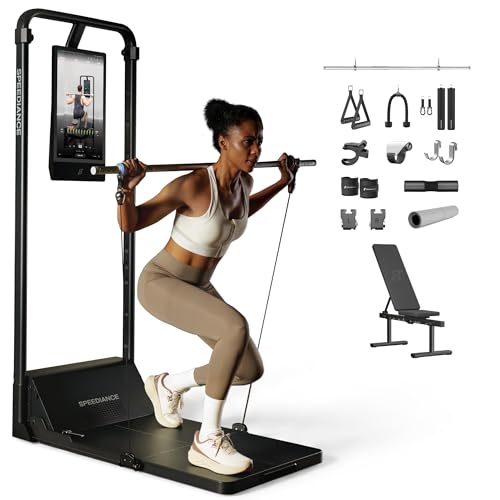
Full-Body Strength Training: The Speediance Gym Monster 2 combines a power cage, Smith machine, squat rack, bench rack, cable machine, and pulley system into one compact home gym for versatile strength training and full-body workouts.

【Innovative Pulley Configuration】 The Mikolo Smith Machine features an innovative pulley configuration that achieves a 2:1 ratio for the functional trainer, internally combining the 2:1 output from each of the two weight stacks to deliver a 264-lb total capacity for lat pulldown and low row. This system enables seamless transitions between lat pulldown, low row, and trolley movements without carabiner adjustments
Training Frequency and Recovery Tips for PPL
While setting up an effective Push-Pull-Legs (PPL) training routine, understanding the optimal frequency and recovery tips is crucial for maximizing gains. Beginners usually benefit from a 3-day split, allowing ample recovery through strategically placed rest days. Intermediate trainees might adjust to a 4-day schedule, alternating push and pull days. Advanced lifters often tackle a 6-day split, hitting muscle groups twice weekly for optimal training adaptations. Recovery techniques, like passive rest or light cardio, help in muscle repair and fatigue reduction. Monitoring signs of overtraining, such as prolonged soreness, is vital. Customizing frequency based on individual recovery capacity, considering factors like age, nutrition, and sleep, ensures progressive overload without risking overtraining. Balancing volume and intensity enhances long-term progress. Incorporating ergonomic support during floor-based core exercises can reduce injury risks and enhance workout effectiveness while maintaining proper form throughout your training sessions.
Enhancing Muscle Activation and Hypertrophy With Dumbbells
Dumbbells, with their versatility and effectiveness, are invaluable tools for enhancing muscle activation and hypertrophy. Through thoughtful activation strategies, we can harness muscle synergy to target specific areas. Dumbbell exercises, like presses and flyes, engage more muscle fibers in the pectoralis major than their barbell counterparts, especially in the lower chest. They also require stabilizer muscle engagement, promoting upper body stability and reducing injury risk. This increased stabilizer activation contributes to overall muscle hypertrophy. Additionally, dumbbells offer a natural movement path, accommodating individual body structures for a more tailored workout. By preventing muscle imbalances, dumbbells ensure balanced growth and improved shoulder development. With their ability to target regional muscle growth, they’re crucial for achieving comprehensive hypertrophy. For home gym enthusiasts, hex-shaped dumbbells with rubber coating provide enhanced grip security and prevent rolling during workouts, making them ideal for maintaining proper form throughout your training sessions.
Optimizing Workout Efficiency With Dumbbells and Bench
Having explored how dumbbells enhance muscle activation and hypertrophy, let’s now focus on optimizing workout efficiency using dumbbells and a bench. By integrating exercise variations like incline, flat, and decline angles, we can target different muscle portions, increasing our workout diversity. Unilateral dumbbell exercises, such as lunges and step-ups, help fix muscular imbalances by forcing each limb to work independently. For intensity techniques, we incorporate tempo control and supersets—combining a dumbbell bench press with rows using the bench. This not only saves time but also maintains high intensity. Additionally, progressive overload through incremental weight increases, alongside drop sets, challenges our muscles effectively. With dumbbells, we can swiftly adjust for multiple exercises, maximizing our session’s density and overall efficiency. The adjustable features of quality weight benches allow for 144 different positions, enabling precise angle modifications that enhance exercise targeting and workout customization.
Safety Considerations and Injury Prevention Tips
Ensuring safety during our workouts is paramount, with several key factors to consider. First, proper technique is essential; establishing four main contact points on benches maximizes stability, while engaging our glutes lightly helps maintain alignment. Warm up routines should include dynamic exercises targeting shoulders, elbows, and hips to prepare our joints and reduce injury risks. Equipment safety involves checking dumbbells and benches for integrity and ensuring sufficient space for movement. Load management means starting with manageable weights and progressively increasing them, allowing rest days to prevent overuse injuries. Injury prevention focuses on balanced muscle development across push, pull, and leg movements, incorporating accessory exercises for joints. When using ab wheels to complement your routine, ensure proper technique to avoid injuries, especially for beginners, and practice on stable, flat surfaces for maximum effectiveness. By adhering to these guidelines, we can workout safely and effectively.
Progressive Overload Strategies With Dumbbells and Benches
When it comes to maximizing our progress with dumbbells and benches, understanding and applying progressive overload strategies is essential. By increasing training volume, we can encourage muscle adaptation effectively. This could involve adding more repetitions, like moving from 8 to 10 reps over weeks, or increasing the number of sets per session. Implementing supersets with bench exercises can amplify volume without extra rest, enhancing resistance progression. Gradually upping dumbbell weights with adjustable options helps maintain form while boosting strength. Adjusting bench angles or incorporating isometric pauses can dynamically modify exercise difficulty. Tracking workouts with logs allows us to systematically tweak variables like weight, reps, and sets, ensuring continuous progress while avoiding overtraining and promoting consistent muscle adaptation.
Frequently Asked Questions
Can PPL Be Adapted for Beginners Using Only Dumbbells and Benches?
Yes, we can definitely adapt PPL for beginners using only dumbbells and benches. Adaptation strategies include beginner modifications like adjusting reps, weights, and rest intervals. This approach ensures effective training while accommodating novice needs and capabilities.
How to Address Muscle Imbalances in a PPL Routine With Dumbbells?
Imagine a seesaw: for balance, both sides must be equal. We address muscle imbalances by incorporating unilateral exercises and ensuring balanced progression, like single-leg squats, to evenly strengthen each side and maintain equilibrium.
What Are Effective Warm-Up Routines for PPL Workouts With Dumbbells?
Let’s kick off our PPL workouts with dynamic stretching and mobility exercises. Arm circles, leg swings, and inchworms will boost flexibility. Light dumbbell presses, lunges, and squats prepare our muscles, ensuring we’re ready for action.
Are There Ways to Incorporate Cardio Into a Dumbbell-Based PPL Split?
Absolutely, we can integrate cardio into a dumbbell-based PPL split through dumbbell cardio and circuit training. By rapidly alternating exercises like step-ups, mountain climbers, and burpees, we boost heart rate and enhance endurance.
How Do I Track Progress in a Dumbbell-Only PPL Program?
We track progress in our dumbbell-only PPL program by consistently logging sets, reps, and weights. Using performance metrics like total volume and achieved targets helps us adjust and ensure progression. Let’s stay accountable and objective together!