As an Amazon Associate, we earn from qualifying purchases. Some links on this site are affiliate links at no extra cost to you. Our recommendations are based on thorough research and editorial judgment.

How Jump Rope Training Improves Coordination and Balance

Jump rope training boosts coordination and balance by requiring synchronized footwork and rhythm, engaging both sides of our brain for neural development. It enhances core stability, strengthens lower body muscles, and improves proprioception, reducing fall risks. Studies show a 30% increase in coordination among regular jumpers. This exercise promotes proper posture and dynamic joint stability, essential for balance. Jump rope efficiently blends physical fitness with cognitive skills, making it an excellent choice for all fitness levels. Discover the further benefits next.
Key Takeaways
- Jump rope training engages both brain hemispheres, promoting neural pathway development and enhancing coordination.
- It requires synchronization of footwork and rhythm, improving fine motor skills and multitasking abilities.
- Jumping rope strengthens lower body muscles, enhancing core stability and balance.
- It improves proprioception and spatial awareness, reducing the risk of falls and injuries.
- Dynamic movement in jump rope training encourages proper posture, supporting overall balance enhancement.
Enhancing Gross Motor Coordination
When it comes to enhancing gross motor coordination, jump rope training is an outstanding method that packs multiple benefits into a single activity. By engaging large muscle groups, such as the arms, legs, and trunk, jump rope exercises significantly improve our motor skills. This activity demands strength, endurance, and postural control, helping us maintain balance while moving. As we synchronize our movements, we develop better body awareness, which is crucial for dynamic activities like running and climbing.
Jump rope training doesn’t just involve rhythmic hopping; it requires precise timing and coordination, enhancing our ability to perform complex motor tasks. The development of these skills supports smoother transitions between movements, reducing the risk of falls and injuries. Modern jump ropes with double-bearing systems allow for smooth, fast rotations that enhance the coordination-building benefits of this versatile exercise. Overall, jump rope is a key tool in boosting our gross motor coordination.
Improving Inter-limb Coordination

Jump rope training does wonders for improving inter-limb coordination, a crucial aspect of athletic performance and daily movement. By engaging both the upper and lower body in rhythmic, synchronized motion, we enhance our limb synchronization techniques. This activity demands precise timing and activation of multiple body segments, promoting coordinated movement drills that refine our neuromuscular pathways. Through complex exercises like alternating foot patterns and crossover jumps, our nervous system adapts to intricate demands, increasing our ability to manage simultaneous limb actions.
Moreover, the integration of visual and motor systems during jump rope sessions sharpens our hand-eye-foot coordination. As we process visual cues in real-time, our reaction times and movement precision improve, making our coordination more automatic and fluid. Incorporating adjustable heights from exercise step platforms into your training routine can further challenge your coordination by adding variable elevation changes that require enhanced limb synchronization.
Maintaining Postural Stability
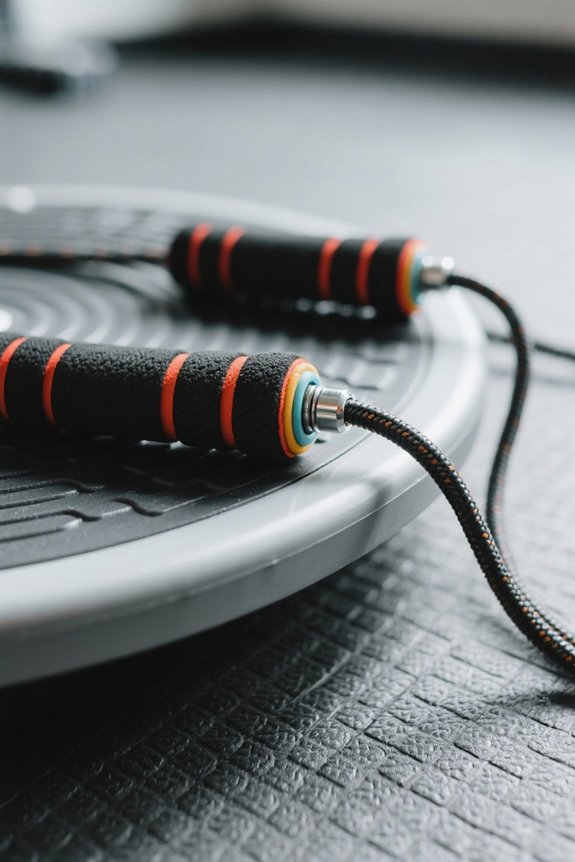
As we refine our inter-limb coordination with jump rope training, we’re also enhancing our ability to maintain postural stability, a foundational element for both athletic and everyday activities. By engaging the plantar foot, jump rope exercises strengthen our postural alignment and stability strategies. For instance, a 12-week jump rope program showed significant improvements in postural control in boys with flexible flat foot, using center of pressure measurements. These exercises not only bolster static balance, as evidenced by the stork stand balance test, but also enhance ankle stability, reducing sway and improving upright postural stability. The rhythmic nature of jumping reinforces neuromuscular coordination, allowing us to maintain our center of gravity efficiently, ultimately compensating for biomechanical deficiencies like flat feet. The coordination benefits are further amplified when using weighted jump ropes, which enhance overall body workouts and promote greater strength building compared to standard options.
Dynamic Balance Development

Dynamic balance development is a crucial aspect of jump rope training, offering us a robust way to enhance our coordination and stability. By engaging in dynamic balance exercises through varied jump rope patterns—like forward, backward, and cross jumps—we effectively improve our dynamic control. Over a 12-week period, youth athletes have shown enhanced Limits of Stability (LOS) and Single Leg Stability Test (SLST) scores, highlighting the benefits of these exercises. Jump rope variations, such as alternating single-leg jumps, support better postural adjustments when our center of gravity shifts. This translates into functional, sport-specific stability, evident in sports like tennis. By synchronizing our movements through rhythmic jumping, we reinforce inter-limb coordination, crucial for maintaining balance during dynamic challenges. The ergonomic handles found on quality jump ropes enhance grip stability, allowing us to maintain better control during complex balance-challenging movements and reducing hand fatigue that could compromise our form.
Proprioceptive and Neuromuscular Adaptations

Building on our exploration of dynamic balance development, we now focus on proprioceptive and neuromuscular adaptations, which are equally transformative aspects of jump rope training. As we engage in rhythmic, synchronized movements, our proprioceptive feedback improves, enhancing body awareness and joint position sense. This is especially true as we incorporate balance challenges, like jumping on unstable surfaces. Our neuromuscular efficiency also benefits; the stretch-shortening cycle in jump rope optimizes neural adaptations, boosting our explosive power and inter-limb coordination. High-intensity interval rope skipping enhances sprint speed and visual reaction time by increasing neuromuscular drive. Over 8 to 12 weeks, these repetitive actions refine our motor unit recruitment, leading to better balance and coordination, critical for athletic performance and daily activities. While jump rope training primarily targets cardiovascular fitness and coordination, incorporating equipment like ab mats can complement your routine by providing additional core stability support during floor exercises.
Gender Differences in Balance Gains
When examining gender differences in balance gains from jump rope training, it’s fascinating to note that both boys and girls benefit significantly, yet differently, from this dynamic exercise. Despite gender variations, balance metrics show no significant differences in dynamic balance improvements between the two. Both genders experience notable within-group enhancements, with boys aged 5-14 and girls aged 9-10 showing marked improvements after weeks of training. Interestingly, girls demonstrate better static balance gains, particularly in the Romberg test with eyes open. Hormonal and muscular differences might explain why males occasionally outperform in static balance. For both genders, jump rope exercises engage anti-gravity muscles and neuromuscular pathways, leading to diverse balance gains. The high-speed rotation capabilities of quality jump ropes with premium bearing systems allow for more consistent training sessions that can maximize these balance improvements across both genders. Thus, jump rope training provides a comprehensive balance improvement platform for everyone.
Cognitive and Brain Function Benefits
Jump rope training doesn’t just improve physical fitness; it also offers remarkable cognitive and brain function benefits. Through cognitive enhancement, we see significant improvements in attention, memory retention, and executive functions. Long-rope jumping activates central monoaminergic systems, particularly norepinephrinergic and serotonergic pathways, enhancing attention and cognitive performance. This exercise-induced neurotransmitter modulation supports enhanced focus and cognitive control. Structured jump rope sessions improve executive functions like response inhibition and cognitive flexibility, which are crucial for decision-making tasks. Additionally, jump rope training boosts working memory across age groups, with studies showing increased accuracy and reaction times on memory tasks. The lightweight construction and ergonomic handles of modern jump ropes reduce fatigue during extended sessions, allowing for longer cognitive training periods that maximize these brain benefits. By stimulating neuroplasticity and cognitive readiness, jump rope contributes to memory retention, helping us perform better academically and in everyday tasks.
Enhancements in Hand-Eye Coordination
Enhancements in hand-eye coordination are one of the standout benefits of jump rope training that we can’t overlook. Jumping rope demands continuous focus and reaction speed, which boosts our neural connections and motor skills. As we track the rope’s movement and synchronize our hand movements with each jump, we strengthen our visual tracking abilities. This jump rope benefit significantly enhances our eye-hand coordination, a vital skill acquisition for both sports and daily activities. Regular practice helps us maintain a consistent rhythm, further refining our coordination. By integrating these dynamic motions, we not only enhance our rhythmic skills but also prepare ourselves for tasks requiring quick visual and motor responses. This training translates to improved performance across various physical pursuits. Similar coordination benefits can be achieved through strength training exercises that require precise movement patterns and controlled motor responses.
Multitasking and Inhibitory Control Improvements
Although we often associate jump rope training with physical fitness, its cognitive benefits, particularly in multitasking and inhibitory control, are equally impressive. Our tests reveal that both high-intensity interval training (HIIT) and moderate-intensity continuous training (MICT) significantly enhance inhibitory control, as measured by faster reaction times in tasks like the Stroop test. HIIT participants showed a mean reduction of 17.012 ms, slightly outperforming MICT’s 14.522 ms decrease. Notably, these gains weren’t observed in control groups, underscoring the unique benefits of jump rope. Furthermore, acute sessions boost inhibitory control and multitasking skills in children, with marked improvements seen even five minutes post-exercise. The rhythmic, error-correcting nature of jump rope sharpens our ability to manage multiple tasks, enhancing cognitive flexibility. For those seeking to maximize these cognitive benefits, weighted jump ropes can provide additional resistance that engages up to 10 times more core muscles than standard ropes, potentially amplifying the neurological demands and cognitive improvements.
Neuromuscular and Muscle Coordination Adaptations
When we explore the realm of neuromuscular and muscle coordination adaptations through jump rope training, we’re delving into a world where physical precision meets dynamic stability. This training enhances neuromuscular efficiency by improving our unconscious motor responses and boosting muscle activation, thanks to rapid eccentric-concentric contractions. These adaptations strengthen neuromuscular regulation in our lower limbs, facilitating dynamic joint stability essential for balance and coordination.
Jump rope training significantly increases muscle-tendon stiffness, crucial for quick force generation during movements. This improved stiffness and the enhanced rate of force development support rapid transitions between muscle actions, aiding balance corrections. Additionally, better neuromuscular coordination boosts movement control, reducing instability and enabling us to maintain balance during complex tasks. This results in a more refined and capable physical performance. The incorporation of high-quality ball bearings in speed jump ropes ensures smooth and fast rotations that further enhance these neuromuscular adaptations during training sessions.
Athlete-Specific Coordination Benefits
In the world of athletics, jump rope training emerges as a pivotal tool for enhancing coordination and balance, especially tailored for athletes. By focusing on sport specificity, jump rope drills improve dynamic balance, crucial for sports requiring rapid directional changes. This training enhances control over the center of gravity, leading to better postural control and reduced injury risk. Furthermore, the synchronous movement of upper and lower limbs boosts inter-limb coordination, sharpening rhythmic timing skills essential for team dynamics in sports like soccer and basketball. Studies even show around a 9% improvement in motor coordination tests. By integrating jump rope into our training, athletes can see enhanced body control and coordination, marking a significant advantage in sport-specific tasks.
Foot Speed and Agility Enhancements
Jump rope training doesn’t just stop at enhancing coordination and balance; it also plays a significant role in boosting foot speed and agility. By engaging our calves and quadriceps in the stretch shortening cycle, jump rope exercises increase the explosive power needed for rapid foot movements. Through footwork drills and speed intervals, we train our muscle fibers to respond faster, enabling quicker elevation and repositioning during athletic activities. Efficient routines focus on working off the balls of our feet, reducing ground contact time and enhancing neuromuscular response. Moreover, jump rope’s rhythmic patterns improve our agility, facilitating smoother transitions and precision in footwork. This combination ensures we can swiftly adapt our foot placement, making jump rope a vital tool for enhancing both speed and agility.
Training Parameters for Optimal Results
To achieve optimal results from our jump rope training, it’s crucial to understand the parameters that guide frequency, intensity, and variety. Training consistency is key—performing sessions at least three times a week over 8 to 12 weeks yields the best gains. Sessions should last 20–30 minutes, including warm-up and cool-down. For intensity, start with basic jumps to build rhythm, then apply progressive overload by introducing faster jumps or weighted ropes as we improve. Interval training, such as 30 seconds of work followed by 30 seconds of rest, can effectively boost coordination. Mixing in exercises like single-leg or lateral jumps keeps our routine dynamic, preventing plateaus. By adhering to these parameters, we ensure steady improvement in coordination and balance.
Progressive Challenges for Continuous Improvement
While embarking on our journey of jump rope training, progressive challenges serve as the cornerstone for continuous improvement. By structuring our training with phased programming, we ensure gradual adaptation, mastering foundational skills before increasing complexity. A 30-day challenge, introducing varied intensity with different rope types and session lengths, helps prevent plateaus. Technique refinement is critical as we advance from basic footwork to more complex skills like crossovers or double unders. Consistency tracking, through self-recording and video analysis, reveals our progress and technique breakdowns. Goal setting, such as max jumps in 15 seconds, quantifies improvements and motivates us. Rest and recovery are essential, allowing tissue adaptation and skill consolidation, ensuring we’re ready for the next level of challenge.
Frequently Asked Questions
How Does Jump Rope Training Impact Mental Focus During Exercises?
Jump rope training enhances our focus during exercises by boosting cognitive benefits such as mental clarity and reduced brain fog. It promotes sustained attention, reduces mental fatigue, and enhances our ability to concentrate through rhythm and repetition.
Are There Any Age Restrictions for Starting Jump Rope Training?
We recommend children start jump rope around age 5-6, while adults of any age, even seniors, can begin with modifications. Beginner tips include using the right rope length and gradually increasing intensity. Always prioritize safety.
What Safety Precautions Should Be Taken During Jump Rope Exercises?
Did you know improper footwear during workouts can increase injury risk by 30%? Let’s start with warm-up exercises to prepare muscles, and ensure we have proper footwear to support our feet and prevent injuries.
Can Jump Rope Training Be Effectively Combined With Other Fitness Routines?
Absolutely, jump rope training can blend seamlessly with other fitness routines. Let’s enhance our combination workouts, bringing fitness variety and efficiency. It adds a dynamic element, boosting cardiovascular fitness and coordination while complementing various exercise regimens.
How Does Jump Rope Training Affect Joint Health Over Time?
Jump rope training is the fountain of youth for our joints, enhancing joint flexibility and offering long-term benefits. By strengthening supporting muscles, it reduces joint stress, ensuring our bodies stay agile and resilient for years to come.