As an Amazon Associate, we earn from qualifying purchases. Some links on this site are affiliate links at no extra cost to you. Our recommendations are based on thorough research and editorial judgment.

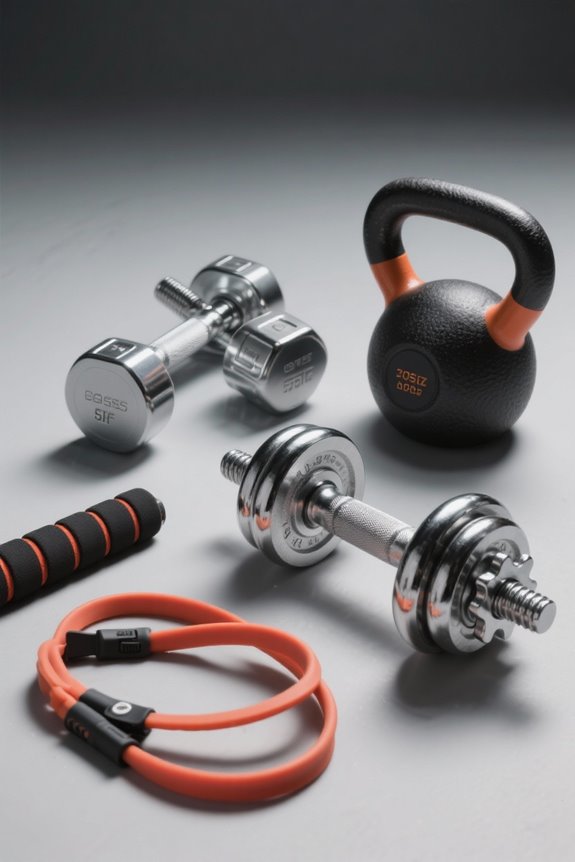
Training for Muscle Endurance Vs Muscle Strength at Home

For effective at-home muscle training, let’s focus on endurance and strength’s unique benefits. Muscle endurance, supported by bodyweight exercises like squats, enhances sustained performance with high reps, offering improved cardiovascular health and fat loss. Conversely, strength training with adjustable dumbbells boosts lean mass and power through progressive overload, essential for combating muscle loss and increasing metabolism. Both can fit seamlessly into your routine with balance, equipment, and nutrition strategies specific to each goal. Want to find out how to get started?
Key Takeaways
- Muscle endurance involves high repetitions with minimal rest, while muscle strength focuses on lower repetitions with heavier weights.
- Home endurance training can include circuit routines, bodyweight exercises, and aerobic step platforms for variety and intensity.
- Strength training benefits from adjustable dumbbells and resistance bands, promoting progressive overload and muscle growth.
- Incorporating both endurance and strength exercises enhances metabolic health, cardiovascular function, and physical power.
- Proper nutrition, including protein and carbohydrates, is crucial for recovery and performance in both endurance and strength training.
Understanding Muscle Endurance
When we talk about muscle endurance, we’re diving into the fascinating ability of our muscles to sustain repeated contractions or maintain force against resistance over time. This endurance primarily involves slow-twitch muscle fibers, which excel at resisting fatigue. Our aerobic capacity plays a crucial role here, as it determines how efficiently these fibers can sustain activity. Enhanced aerobic capacity means better oxygen delivery to muscles, supporting prolonged exertion. Muscle endurance isn’t just about maintaining power; it’s also about neuromuscular adaptations and improved efficiency of our aerobic energy systems. Physiological markers like lactate threshold and anaerobic threshold are pivotal, defining how long we can maintain high-intensity efforts. Understanding these factors helps us appreciate the complex dynamics of muscle endurance. Resistance bands can be particularly effective for building muscle endurance at home, as they provide adjustable resistance levels that allow for high-repetition training across various muscle groups.
Key Benefits of Muscle Endurance Training

Muscle endurance training offers an array of benefits that extend beyond just improving our stamina. By enhancing fat metabolism, it increases fat oxidation, allowing us to burn more calories during and after exercise. This leads to sustainable fat loss, especially with frequent training sessions. Improved cardiovascular function is another key advantage, as endurance training lowers resting heart rate and diastolic blood pressure, reducing cardiovascular disease risk.
Moreover, endurance training bolsters sustained muscular performance. Our muscles resist fatigue longer, making prolonged activities more manageable. It also enhances motor unit recruitment, leading to better coordination and quicker force development. The positive metabolic effects include improved glucose homeostasis and reduced visceral adiposity. For home-based endurance training, incorporating aerobic step platforms can add variety and adjustable intensity levels to create more challenging workout routines. Overall, this training supports better muscle recovery and offers practical scalability for consistent exercise routines.
Principles of Muscle Strength

Building muscle strength isn’t just about lifting the heaviest weights possible—it’s a science grounded in the principles of overload. By employing progressive overload, we consistently challenge our muscles, increasing weights, reps, or sets to stimulate growth. Training within specific strength zones optimizes muscle adaptation, targeting high-load sessions for maximal strength. Reaching muscle failure during workouts is essential, pushing our muscles to their limits for maximum gains.
Exercise variety enriches our routine, combining compound and isolation movements to engage all major muscle groups. Equally critical is the recovery importance; adequate rest between sets and workouts ensures muscles repair and grow stronger. Quality equipment with durable steel construction ensures safety and stability when training with heavy loads for maximum strength development. Incorporating these principles into our strength training regimen at home sets the foundation for significant strength development.
Advantages of Muscle Strength Training

Strength training offers a multitude of benefits that extend far beyond merely building muscle. By focusing on muscle hypertrophy and strength progression, we enhance our ability to perform daily tasks with ease, boosting our quality of life. It increases lean muscle mass, which directly contributes to overall physical power and endurance. As we age, strength training helps us combat the natural muscle loss of 3%-8% per decade, supporting functional independence, especially for older adults.
Moreover, strength training improves metabolic health by raising our resting metabolic rate, allowing us to burn more calories at rest. It significantly reduces abdominal fat, lowering the risks of heart disease, type 2 diabetes, and certain cancers. Additionally, it enhances bone density, joint strength, and cardiovascular health, promoting longevity and overall well-being. To maximize safety and comfort during strength training workouts, consider investing in quality foam gym flooring that provides shock absorption and protects your joints during high-impact exercises.
Equipment Essentials for Home Workouts

As we focus on enhancing our physical capabilities at home, having the right equipment is fundamental to maximizing the benefits of our workouts. A well-planned home gym setup requires essential equipment like barbells and adjustable dumbbells, which are crucial for compound movements and scalable resistance. Barbells, combined with weight plates, allow us to perform heavy lifts like squats and bench presses, enabling progressive overload. Dumbbells offer versatility for both upper and lower body exercises. For varied intensity and space efficiency, adjustable dumbbells and kettlebells are excellent additions. Modern adjustable dumbbells feature quick weight changes in 2.5-pound increments, allowing seamless transitions between strength and endurance training phases. Resistance bands and pull-up bars are perfect for building endurance and strength, while plyometric boxes and jump ropes cater to dynamic, explosive movements. A weight bench expands exercise options, enhancing posture and load management.
Designing a Muscle Endurance Routine
Crafting a muscle endurance routine requires strategic planning, ensuring we maximize stamina and fatigue resistance through structured exercises. Circuit training forms the backbone of our program, allowing us to perform multiple exercises in sequence with minimal rest, enhancing endurance progression. We’ll leverage exercise variation to keep our muscles challenged, focusing on bodyweight exercises like push-ups and squats that support high reps. Volume recommendations suggest 12-25+ repetitions per set, performed 2-4 times weekly, ensuring a balanced training frequency. Recovery strategies are crucial, so we must manage fatigue by monitoring rest intervals and including active recovery days. By gradually increasing reps or decreasing rest, we can progress effectively while maintaining a sustainable routine and preventing overtraining. Incorporating agility ladders into your endurance routine can enhance footwork precision and coordination while supporting high-intensity interval training to boost overall conditioning.
Creating a Muscle Strength Training Plan
When we move from building muscle endurance to focusing on muscle strength, it’s all about optimizing your home workouts for maximum power and efficiency. To create an effective muscle strength training plan, start by prioritizing compound exercises like squats and bench presses, which engage major muscle groups. Schedule these sessions at least twice a week per muscle group, allowing 48-72 hours of rest for recovery. Exercise frequency is crucial, so pair complementary muscle groups, such as arms and shoulders, to optimize recovery strategies. Aim for 8 to 12 repetitions per set, using a weight that challenges without compromising form. Track progress through increased intensity over time, ensuring you’re always working near maximal effort for continual strength gains. For home strength training, consider investing in adjustable dumbbells that can accommodate weight ranges from 5 to 200 lbs, allowing you to progressively increase resistance as your strength improves.
Incorporating Bodyweight Exercises
Incorporating bodyweight exercises into our strength training routine at home isn’t just practical; it’s also an incredibly effective method to enhance both endurance and strength. With bodyweight progression, we can steadily advance by increasing reps or altering leverage, ensuring continuous improvement without equipment. Such exercises significantly boost core stability, essential for maintaining balance and preventing injuries. For instance, engaging in planks and push-ups not only targets our core but also enhances overall muscle endurance, with studies showing up to an 11% increase. Moreover, the functional nature of bodyweight movements, which engage multiple muscles, improves coordination and mimics real-life activities. This adaptable training improves flexibility, aerobic capacity by 33%, and even lower-body power by 6%, offering a holistic fitness approach. Additionally, incorporating equipment like reflex bags can further enhance hand-eye coordination and reaction speed, complementing bodyweight exercises for a more comprehensive athletic training regimen.
Using Resistance Bands for Versatile Training
While exploring the realm of home fitness, using resistance bands offers a versatile training approach that’s both efficient and effective. Resistance band exercises provide continuous tension, enhancing muscle activation in ways similar to free weights. The bands’ color coding represents varying resistance levels, allowing us to progress from light to heavy tension, which is great for different exercises and muscle groups. These bands facilitate multi-planar strength exercises like pressing, pulling, and curling, effectively targeting major muscle groups. They’re also perfect for endurance training, enabling high repetition sets without excessive joint strain. Compact, lightweight, and inexpensive, resistance bands can be anchored almost anywhere, making them a convenient tool for maintaining consistent workouts at home or while traveling. Quality bands made from natural latex provide superior elasticity and durability compared to synthetic alternatives, ensuring reliable performance throughout your training sessions.
Adjusting Dumbbells and Kettlebells for Home Use
Exploring the world of adjustable dumbbells and kettlebells for home use opens up a realm of possibilities for versatile strength and endurance training. With weight selection options in 2 kg or 5 lb increments, these tools cater to both beginners and advanced users. Various adjustment mechanisms, such as dials, pins, and manual loading, provide flexibility and ease of use. The comfort grip, especially with matte powder-coated handles, ensures safety and control during workouts. Our home storage becomes more efficient with their compact designs, combining multiple weights into a single unit. Additionally, features like rubber bottoms protect flooring, making them ideal for home gyms. Quick-change mechanisms enhance workout efficiency by allowing for faster transitions during training sessions. By focusing on these elements, we can enhance our training experience and effectively reach our fitness goals.
Implementing Progressive Overload Techniques
Adjustable dumbbells and kettlebells have shown us the versatility possible in home workouts, and now it’s time to enhance our training by implementing progressive overload techniques. By increasing resistance, even small increments of 1–2.5 kg can lead to significant training adaptations. It’s crucial to maintain proper form to prevent injury and ensure muscles engage effectively. Alongside weight, we can increase training volume by adding more reps or sets, boosting endurance. Shortening rest intervals by 5–10 seconds enhances metabolic stress, driving endurance gains. Additionally, varying exercise selection, such as incorporating deficit push-ups or jump squats, keeps muscles challenged and avoids plateaus. Manipulating tempo, like slowing the eccentric phase, also augments time under tension, fostering both strength and endurance.
Nutritional Strategies for Muscle Training
When it comes to maximizing our muscle training efforts, nutrition plays a crucial role in supporting both endurance and strength gains. We need to focus on protein timing, ensuring intake within 30 minutes to 2 hours post-exercise to boost recovery and muscle growth. Carbohydrate sources like fruits and whole grains provide energy, especially for endurance training. Hydration needs can’t be overlooked; proper fluid intake supports muscle function and recovery strategies. A balanced fat intake from sources like olive oil aids hormone production and energy. Meal planning should include diverse foods to maintain nutrient balance and micronutrient support, ensuring a steady supply of iron, calcium, and vitamin D. By considering these nutritional strategies, we can optimize our training outcomes effectively.
Balancing Endurance and Strength in Your Routine
Balancing endurance and strength in our exercise routine is essential for maximizing fitness outcomes, and it requires thoughtful planning and execution. By distributing strength and endurance sessions across the week, like three days of strength and two days of endurance, we optimize recovery and performance. Alternating these sessions, we enjoy cross training benefits that prevent fatigue and enhance workout variation. Incorporating compound movements, such as squats and deadlifts, efficiently builds strength. Pairing these with high-rep, low-load exercises boosts endurance. Alternating intensity and volume helps prevent plateaus. Additionally, including complete rest and active recovery days guards against overtraining. By structuring our routine with thoughtful variation, we support both muscle endurance and strength, achieving a balanced, effective home workout regimen.
Frequently Asked Questions
How Often Should I Train for Muscle Endurance and Strength Each Week?
We should aim for an ideal frequency of 3-5 times a week for endurance and 3-4 times for strength. A balanced workout split allows us to target both goals while ensuring proper recovery and progress.
Can I Combine Both Endurance and Strength Training in a Single Session?
Yes, we can combine both endurance and strength training in a single session. However, let’s structure it carefully to minimize fatigue, alternating exercises strategically to maintain effectiveness and balance the workout load efficiently.
What Are the Signs of Overtraining in Muscle Endurance and Strength Workouts?
In overtraining, we experience fatigue indicators like prolonged soreness and decreased performance. Let’s focus on recovery techniques such as rest days and proper nutrition to restore balance and prevent injuries, ensuring our training remains effective and sustainable.
How Can I Prevent Injury While Training for Endurance and Strength at Home?
We can prevent injury by focusing on proper form, using gradual progression, and employing recovery strategies. Always warm up, cool down, and rest adequately. Listening to our bodies helps avoid overtraining and ensures safe home workouts.
Are There Any Specific Warm-Up Routines for Endurance Versus Strength Training?
What’s the best way to tailor warm-ups for our goals? Dynamic warm-ups with activity-specific stretches are key. For endurance, focus on light cardio and mobility; for strength, target neuromuscular activation and gradual intensity increase.