As an Amazon Associate, we earn from qualifying purchases. Some links on this site are affiliate links at no extra cost to you. Our recommendations are based on thorough research and editorial judgment.

Adapting Dumbbell Workouts for Joint-Friendly Training

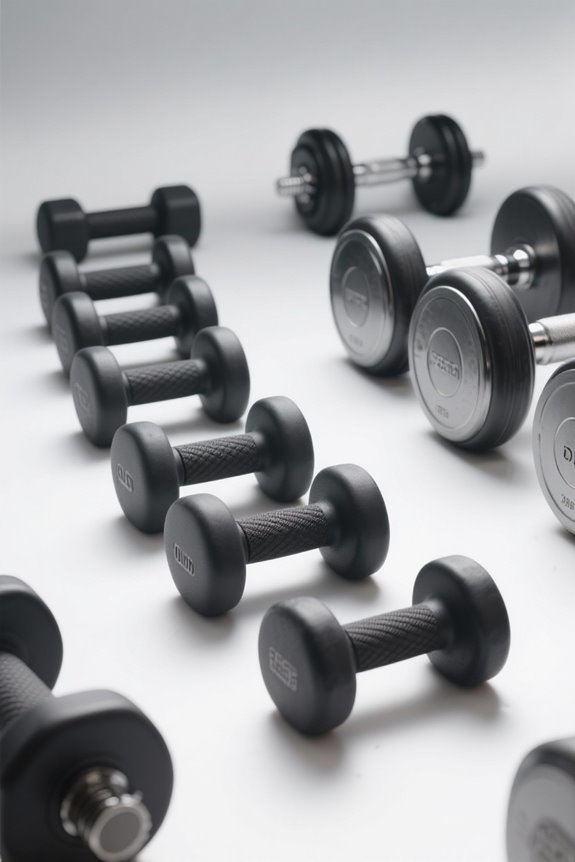
Let’s adapt our dumbbell workouts for joint-friendly training by focusing on exercises that promote joint mobility and stability. We’ll incorporate movements like glute bridges, Romanian deadlifts, and dumbbell scaption, which minimize joint strain while enhancing muscle engagement. Adjustable dumbbells with ergonomic grips can cater to varying fitness levels as we gradually increase load and repetition. By monitoring joint responses and adjusting exercises, we’ll ensure optimal joint health and safer workouts. Learn more about these techniques and their impact.
Key Takeaways
- Select joint-friendly exercises like glute bridges and Romanian deadlifts to minimize joint strain during workouts.
- Use adjustable dumbbells with ergonomic grips to ensure comfort and safety during training sessions.
- Implement controlled repetition techniques with light to moderate weights to reduce stress on joints.
- Progress gradually with slow eccentric phases and incremental increases in sets or reps for sustainable joint adaptation.
- Monitor joint comfort and use digital tools for real-time assessment to adjust workouts accordingly.
Benefits of Dumbbell Training for Joint Health
When it comes to keeping our joints healthy, dumbbell training offers a host of benefits that are both practical and effective. By promoting enhanced muscle symmetry, dumbbells help us develop balanced strength on both sides of our body, which is essential for reducing muscle imbalances. This balance is key in injury prevention, as it ensures our joints experience less strain during exercises. Additionally, the natural movement patterns allowed by dumbbells further minimize the risk of injury, offering a more joint-friendly workout. The versatility in exercises also means we can tailor our routines to maintain joint health. Improved stabilizer engagement is another significant advantage, as it enhances joint stability, supporting our functional strength in everyday activities. The ergonomic designs of modern dumbbells improve grip stability and workout safety, making them particularly beneficial for those prioritizing joint health during strength training.
Recommended Products

Targeted Quad Isolation for Superior Strength Gains - Engineered to precisely isolate and strengthen the quadriceps, this leg workout equipment helps build powerful, defined legs and improves knee joint support.

The Original NUOBELL : Premium 5–80 lb Adjustable Dumbbells for Home Gym Training - These authentic SMRTFT NUOBELL adjustable dumbbells deliver smooth weight changes and dependable performance across the full 5–80 lb range. A true adjustable dumbbells set built for serious home gym athletes.

32 Dumbbells in 1 for Total Body Workout – Designed for both men and women, the Nuobell adjustable dumbbells offer a range of adjustable weights from 5 to 80 lbs, perfect exercise equipment for a complete home workout.
Selecting Joint-Friendly Dumbbell Exercises

Selecting joint-friendly dumbbell exercises is essential for maintaining joint health while achieving fitness goals. We can explore dumbbell variations like glute bridges, which target glutes and hamstrings while minimizing joint strain. Exercise modifications such as Romanian deadlifts use hip hinge mechanics, reducing stress on knees and lower back. For shoulders, dumbbell scaption protects against impingement, promoting stability. Triceps kickbacks isolate elbow stabilizers, decreasing joint stress. Renegade rows and bent arm pullovers enhance core and shoulder stability, preventing overuse injuries. Dumbbell goblet squats engage the core, providing balanced biomechanics. Unilateral exercises, like Bulgarian split squats and step-ups, improve balance and joint control. These thoughtful selections ensure we’re prioritizing joint health without compromising on strength or functional fitness. A quality adjustable weight bench provides multiple positioning options that support proper form and reduce joint stress during these exercises.
Recommended Products

Full-Body Strength Training: The Speediance Gym Monster 2 combines a power cage, Smith machine, squat rack, bench rack, cable machine, and pulley system into one compact home gym for versatile strength training and full-body workouts.

INDUSTRY LEADER: For 30+ years, Body Solid has held the widest array of products designed to meet the demands of the ever-changing fitness industry (home gym, free weight machines, treadmills, bikes, ellipticals, weight plates, kettlebells, dumbbells, flooring, accessories and more). Our products are cutting edge and reliable and are built for Life……Your Life.

【True 1:1 Pulley Advantage】The PMAX-4750 Plate Loaded Smith Machine features a true 1:1 functional trainer: the weight you load is the weight you lift. Ideal for strength and progressive overload, it delivers an authentic free-weight feel with Smith safety. A 2:1 option provides smoother, lighter resistance—great for endurance, pump work, or rehab. Few home gyms offer both, making this Smith exceptionally versatile.
Repetition and Load Strategies for Joint Safety

Incorporating repetition and load strategies thoughtfully ensures our workouts are joint-friendly, promoting long-term joint health without sacrificing strength. By implementing controlled repetition techniques, like slow and super slow training, we can reduce joint stress by eliminating momentum and focusing on muscle tension. Load management plays a critical role as well; using light to moderate weights helps maintain muscle engagement without straining our joints. Gradual progressive loading is essential, allowing us to increase strength while being mindful of joint comfort. Additionally, focusing on eccentric phases rather than concentric ones offers strength gains with less joint stress. Avoiding maximum lifting efforts is crucial for reducing joint damage, ensuring we can sustain our training routines for years to come. Adjustable dumbbells with 5-pound increments provide the precise weight progression needed for joint-safe strength training, allowing for gradual increases that respect joint limitations.
Recommended Products

The Original NUOBELL — Trusted, Safe, and Built to Perform : Our patented design supports the full 5–100 lb range safely and smoothly, giving you the performance and durability expected from the #1 premium adjustable dumbbell.

Handle twist quickly adjusts weight in 5 lb. increments

Limited Lifetime Warranty: Worries-free on all parts including the anti-slip handle, weights/disks, and the storage tray.
Progression Tips for Joint Adaptation

Progressing safely in our workouts is crucial for joint adaptation, ensuring we build strength without overloading our bodies. To enhance joint movement, we can employ adaptive techniques like slowing the eccentric phase, which reduces joint impact and allows better control. Starting with a two to three-second eccentric phase and gradually extending to four to five seconds helps joints adapt. Initially, partial range of motion (ROM) can prevent irritation, with gradual increases as comfort improves. We should focus on stability by starting with bilateral exercises, progressing to unilateral movements once joint stability is solid. It’s important to monitor joint responses, adjusting volume and frequency as needed. Incremental increases, such as adding one set or two reps, ensure sustainable progression. For additional joint support during floor exercises, consider using equipment with high-density foam that provides lower back support and helps maintain proper spine alignment throughout your movements.
Supporting Joint Health With Resistance Training
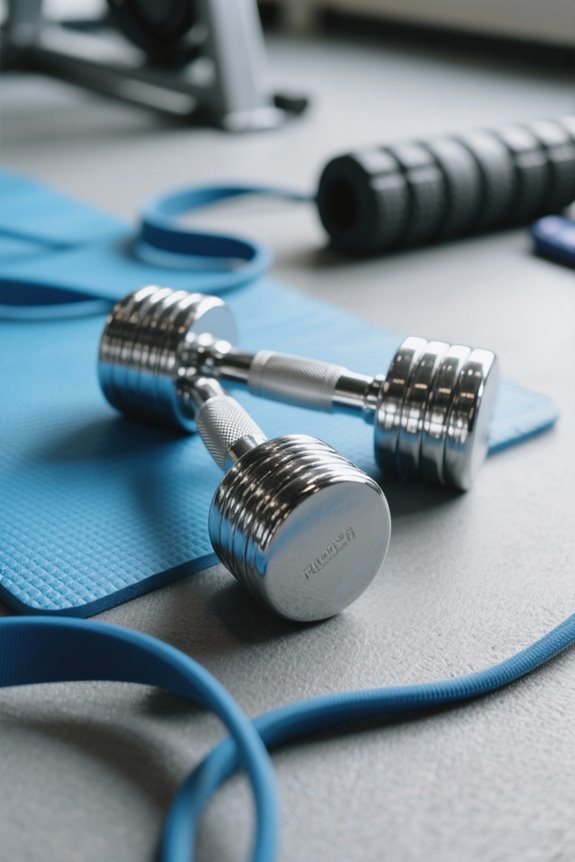
While resistance training might seem intimidating at first, it’s an essential component for supporting joint health, particularly for those of us dealing with osteoarthritis. By focusing on joint protection through resistance adaptations, we can significantly improve pain and function, especially in knee and hip OA. Studies show that moderate-intensity resistance training enhances muscle strength, particularly in the quadriceps, improving joint stability and function. Over time, this can lead to reduced cartilage loss and joint space narrowing, crucial for maintaining joint health. Regular strength training is associated with a 20% lower risk of developing knee OA and pain in older adults, even if started later in life. These benefits emphasize the importance of incorporating resistance training into our routines. For those seeking alternatives to traditional weights, resistance bands can provide effective strength training while minimizing joint stress compared to free weights.
Practical Tips for Joint-Friendly Dumbbell Workouts
Let’s build on the foundation of supporting joint health with resistance training by exploring practical tips for joint-friendly dumbbell workouts. Maintaining joint resilience begins with exercise modifications like using lighter weights to minimize joint strain. Controlled movements and proper form are crucial, reducing unnecessary stress and preventing injuries. Limiting the range of motion when needed helps avoid joint discomfort, while a thorough warm-up and stretching routine prepares muscles and joints for activity.
Incorporate standing exercises to reduce transitions that stress joints, and avoid high-impact moves like jumping. Ensure workouts are structured with short intervals and rest periods to prevent joint fatigue. Don’t forget about breathing techniques, which enhance stability and reduce tension. Always remain aware of pain, consulting professionals if necessary, to maintain joint health. Consider incorporating push-up bars into your routine, as their ergonomic design reduces wrist strain compared to traditional floor exercises.
Recommended Products

Fairly Easy to Assemble: The fitness trampoline adopts an octagonal foldable design, 50% of the elastic ropes are pre-assembled, and after unfolding, it only takes 10 minutes to assemble with our special tools. Make the installation simple and safe!

Sturdy and Durable Construction: Built with high-quality, thickened stee, supporting weight capacities up to 440 lbs. Features like safety locknuts, sturdy frame connections ensure stability without wobbling during intense workouts like pull-ups, dips, or push-ups.

4-IN-1 MULTI-FUNCTIONAL DESIGN: Transform your home gym with a single set: Use as dumbbells (5-86 lbs adjustable), barbells, kettlebells, or push-up stands. Perfect for strength training, muscle toning, HIIT workouts, and full-body exercises.
Choosing the Right Dumbbell Exercises for Joint Tolerance
When selecting dumbbell exercises to support joint tolerance, it’s crucial to consider both joint load and movement patterns to ensure a safe yet effective workout. Opting for dumbbell variety allows us to tailor exercises to different joint needs. Multi-joint exercises, such as reverse lunges with overhead presses, engage several muscle groups but may increase joint complexity. In contrast, single-joint exercises like bicep curls offer joint specific adaptations with less stress. We should avoid high-impact moves to minimize joint strain, focusing instead on controlled movement patterns that enhance stability and strength. Adjusting reps between 6-12 and gradually increasing weights can support joint health. By prioritizing exercises that don’t exacerbate discomfort, we can maintain effective training while protecting our joints. Incorporating adjustable dumbbells with ergonomic grips can further enhance safety and comfort during extended joint-friendly workouts.
Recommended Products

Home Gym Equipment Weight Set:Includes 5, 10, 15, 20, 25, 30, 35, 40, 45, 50, 55, 60, 65, 70, 75, 80, 85, 90, 95, and 100lb dumbbell pairs, (2) of 3-tier racks and (2) of mats. You can use these solid dumbbells in a wide range of exercises, also a perfect choice for both beginners or athletes.

💪 Best Home Gym Equipment: Includes 5, 10, 15, 20, 25, 30, 35, 40, 45, 50, 55, 60, 65, 70, 75, 80, 85, 90, 95, and 100lb dumbbell pairs, (2) of 3-tier BLUE RACKs and (2) of MATs. You can use these solid dumbbells in a wide range of exercises, also a perfect choice for both beginners or athletes.

FEATURES: Synchronized articulating functional training arms with range extending from upper ab exercises to side accessed workouts
Emphasizing Joint Mobility and Stability
Incorporating joint mobility and stability exercises into our fitness regimen is essential for maintaining overall joint health and function. By using dumbbell rotations and mobility transitions, we can enhance our range of motion and bolster joint stability. For instance, light-to-moderate dumbbells, about 25-50% of our heaviest lift, allow us to perform controlled movements like Arm Circles and Side Bends, improving shoulder and torso flexibility. Over time, these exercises help prevent declines in joint range of motion, which can occur with age. Weighted mobility flows, such as transitioning between bear and crab positions, challenge stability across multiple planes. Adding static stretching post-workout further increases flexibility, supporting both mobility and stability efforts and reducing injury risk in daily activities. Small exercise balls can complement these dumbbell routines by providing additional stability training and core engagement during rehabilitation exercises.
Monitoring Joint Comfort and Movement Quality
Although maintaining joint comfort and movement quality might seem complex, it’s essential for effective and safe dumbbell workouts. By conducting thorough movement analysis, we can identify joint discomfort sources and make necessary adjustments. Goniometry, a reliable method for measuring joint range of motion (ROM), helps us track progress precisely. Digital goniometers and inclinometers offer real-time precision, while sensor fusion provides robust joint angle assessments using flex sensors and gyroscopes. For movement quality, we assess joint motions like end-range play, utilizing stiffness grading scales to classify mobility. Monitoring pain levels during exercises with numeric rating scales allows us to modify routines in real-time, ensuring joint-friendly training. Consistent assessment aids in targeting treatment and enhancing overall movement quality. Using workout floor mats with optimal cushioning between ½ inch to 1 inch thickness provides additional joint support during dumbbell exercises, particularly for high-impact movements.
Frequently Asked Questions
How Can I Modify Dumbbell Exercises for Limited Joint Mobility?
Did you know 1 in 4 adults has joint pain? We can modify dumbbell exercises by incorporating joint-friendly techniques like exercise variations, slow controlled movements, and reduced range of motion to accommodate limited joint mobility and avoid discomfort.
What Are the Signs of Joint Overuse in Dumbbell Training?
We can spot joint overuse in dumbbell training through pain indicators like persistent pain, swelling, stiffness, and decreased mobility. Recognizing these signs lets us make necessary workout adjustments to avoid further injury and discomfort.
Can Dumbbell Workouts Aid in Recovering From Joint Injuries?
Yes, they can. Like a phoenix rising, our bodies can utilize dumbbell workouts for rehabilitation exercises and mobility enhancements. By gently engaging muscles, we support joint recovery, foster healing, and reclaim the freedom of movement.
How Do I Balance Joint-Friendly Training With Muscle Growth Goals?
Let’s focus on joint safety by choosing exercises that encourage muscle adaptation without overstressing joints. We’ll use controlled tempos, moderate weights, and balance exercises to support muscle growth while ensuring our joints are protected and healthy.
Are There Specific Dumbbell Brands Designed for Joint Comfort?
We haven’t found any specific dumbbell brands solely designed for joint comfort. However, brands with ergonomic designs and cushioned grips, like CORETEZ and Lifepro, offer features that could indirectly support joint comfort during workouts.