As an Amazon Associate, we earn from qualifying purchases. Some links on this site are affiliate links at no extra cost to you. Our recommendations are based on thorough research and editorial judgment.


What Is Tempo Training and How to Apply It With Dumbbells

Tempo training is all about controlling movement speed to boost muscle growth and strength, using dumbbells to control the time under tension. Each repetition’s divided into four phases: eccentric, pause after lowering, concentric, and pause after lifting. We can tweak these phases to challenge our muscles, prolong tension, and minimize momentum. Adjustable dumbbells allow for seamless weight variation, enhancing workout versatility. Stick around to discover how this method transforms your fitness routine.
Key Takeaways
- Tempo training alters movement speed to control time under tension, enhancing muscle strength and growth through precise muscle development.
- Tempo notation consists of four phases: eccentric, isometric pause, concentric, and isometric pause, guiding controlled exercise execution.
- Adjustable dumbbells offer versatility for varying weight ranges in tempo training, accommodating different strength levels and exercise demands.
- Slowing the eccentric phase boosts muscle recruitment and enhances joint stability, reducing injury risk while building strength.
- Incorporate tempo training 1-3 times weekly, varying parameters to optimize adaptations and maintain workout engagement.
Understanding the Basics of Tempo Training
When we dive into the world of tempo training, it’s essential to grasp the foundational elements that make this approach so effective. Tempo principles focus on modifying movement speed to control time under tension (TUT), enhancing training efficiency by targeting muscle strength and growth. By adjusting each phase’s duration in a lift, we can achieve more precise muscle development. Typically, tempo is represented by a sequence of numbers indicating seconds spent on different phases: lowering, pause, lifting, and top pause. This precision allows us to fine-tune our workouts for better strength gains and muscle control. For home gym enthusiasts looking to implement tempo training effectively, adjustable dumbbells provide the versatility needed to progress through different weight ranges while maintaining precise control over movement phases.
Applying tempo to exercises, especially focusing on the eccentric phase, can optimize the benefits of TUT, ensuring that our training is both effective and efficient.
Key Components of Tempo Training Explained
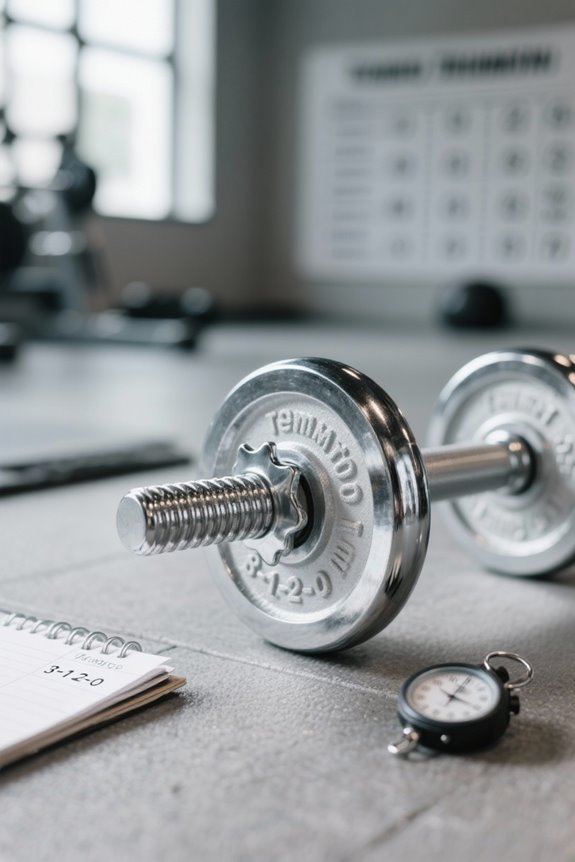
Now that we’ve established a strong foundation in the basics of tempo training, it’s time to break down the key components that make this method so effective. At its core, tempo training involves tempo variations and an eccentric focus, crucial for maximizing muscle engagement. We split each rep into four phases: eccentric, pause after eccentric, concentric, and pause after concentric, often noted as four numbers like 3-1-1-0. This systematic approach influences muscle fatigue and control. Slowing the eccentric phase, where muscles lengthen, boosts microtrauma and muscle recruitment, leading to strength gains. Pauses enhance muscle tension, eliminating momentum for improved control. By mastering these elements, we ensure each repetition contributes effectively to our muscle development and strength. When implementing tempo training at home, adjustable dumbbells provide the versatility to modify resistance across different weight ranges, allowing for precise load management throughout various tempo phases.
The Benefits of Tempo Training for Muscle Growth

Although tempo training might initially seem intricate, its benefits for muscle growth are both substantial and accessible. By extending the time under tension (TUT) through slower eccentric and concentric phases, we amplify hypertrophy mechanisms. This approach promotes metabolic stress, a key driver of muscle growth. Studies reveal that a medium tempo, such as a 3-second eccentric phase, can deliver hypertrophy comparable to faster tempos with heavier loads. Additionally, the extended lowering phase in tempo training enhances mechanical tension and induces microscopic muscle damage, stimulating anabolic signaling pathways. By focusing on controlled movement, we maximize muscle fiber recruitment and minimize reliance on momentum. This method ensures target muscles work harder, fostering robust muscle adaptations while maintaining manageable mechanical stress. For those working out in limited spaces, a compact exercise bench can provide the stable platform needed to perform tempo dumbbell training effectively while saving valuable workout area.
How Tempo Training Enhances Strength Development
Tempo training significantly boosts strength development by optimizing both neural adaptations and muscle recruitment. By controlling movement speeds, we challenge our neural pathways, which leads to better muscle activation. Faster tempos, particularly during the concentric phase, enhance our neural adaptations and improve lifting velocity. However, it’s important to remember that individual differences, such as muscle fiber type, can affect how effective tempo training is for each of us. Consistency is key—regularly incorporating tempo training can lead to progressive strength improvements.
Moreover, manipulating time under tension (TUT) through slower tempos helps extend the duration muscles are under strain. This approach, even with lighter loads, can significantly enhance strength. By balancing load and tempo, we can maximize strength gains while ensuring safety and effectiveness. For those looking to expand their tempo training beyond dumbbells, incorporating dip station exercises can provide additional bodyweight resistance options that complement controlled movement patterns.
Improving Movement Quality With Tempo Training
When we focus on improving movement quality with tempo training, we’re diving into a method that offers significant benefits for our overall fitness journey. By enhancing movement awareness and motor control, we can refine our technical skills and boost neuromuscular efficiency. Tempo training requires us to slow down our reps, which strengthens our nervous system’s ability to sense joint positions and muscle activation. This deliberate pacing improves our proprioceptive feedback, helping us identify subtle imbalances or weaknesses that fast reps might hide. As we reinforce precise muscle engagement patterns, we reduce reliance on momentum and cultivate consistent technique. This practice translates into smoother, more reliable movement patterns, allowing us to execute complex lifts like squats and overhead presses with greater stability and confidence. Similar to how battle ropes engage multiple muscle groups while requiring controlled movement patterns, tempo training with dumbbells creates comprehensive neuromuscular adaptations that enhance overall coordination and strength.
Injury Prevention Through Controlled Movements
By integrating controlled movements into our workout routines, we significantly enhance our ability to prevent injuries. Tempo training improves joint stability by eliminating abrupt motions and ensuring we maintain correct form. This focus on precise movement aids injury mitigation by revealing weaknesses or instabilities, such as in our hips or ankles, allowing us to address them before they cause harm. Slowing the eccentric phase increases proprioception, offering better joint awareness and reducing reliance on momentum, which lowers stress on connective tissues. Furthermore, consistent tempo habits enhance motor control and neuromuscular coordination, refining our movement mechanics and minimizing erratic joint loading. By using lighter weights, we can still achieve strength gains while reducing injury risk, making tempo training an essential tool. When selecting equipment for tempo training, ensuring weight capacity exceeds your training loads provides the stable platform necessary for maintaining proper form throughout controlled movements.
Applying Tempo Training Principles to Dumbbell Exercises
Exploring the world of tempo training with dumbbells allows us to apply the principles of controlled movement to enhance not just strength, but also our overall workout efficiency. By adjusting the tempo, we can increase muscle time under tension and focus on precise muscle engagement. Dumbbell variety plays a key role, as exercises like goblet squats and dumbbell chest presses benefit from different tempo adjustments. For instance, slowing down the descent in a goblet squat emphasizes the eccentric phase, while a quick curl in bicep curls enhances muscle control. This adaptability ensures our workouts remain challenging and engaging. Tempo training not only boosts muscle growth and strength but also adds variety, making each session more effective and enjoyable. To maximize the effectiveness of tempo training with dumbbells, having a quality adjustable weight bench provides the stable platform needed for proper form during incline, decline, and flat pressing movements.
Using Tempo Notation for Effective Workouts
Understanding tempo notation is crucial for crafting effective workouts, providing us with a structured yet adaptable framework to optimize our training. Tempo notation, consisting of four numbers, dictates the duration of each exercise movement phase: eccentric, isometric at bottom, concentric, and isometric at top. For instance, in a “4-1-X-2” format, the eccentric phase takes 4 seconds, followed by a 1-second bottom pause, an explosive lift, and a 2-second top pause. This precise phase timing allows us to explore exercise variations and control time under tension, crucial for strength and hypertrophy gains. By adjusting tempo, we can manipulate mechanical tension and muscle control, ensuring each phase contributes effectively to our desired training outcomes. When implementing tempo training at home, adjustable dumbbells provide the versatility to customize resistance across various fitness levels while maintaining the precise control needed for effective tempo-based workouts.
Tempo Training for Hypertrophy: A Detailed Approach
When it comes to building muscle size through tempo training, it’s essential to understand the nuanced role tempo plays in hypertrophy-focused workouts. By manipulating tempo variations, we can enhance muscle engagement and maximize time under tension (TUT), a crucial element for growth. Typically, hypertrophy-focused tempos range from 2 to 8 seconds per rep. Emphasizing the eccentric phase, often 2-4 seconds, can increase metabolic stress and muscle damage, promoting growth without exceeding 8 seconds per rep. While excessively slow tempos, over 10 seconds, aren’t as effective, moderate tempos can provide significant gains. Research suggests minimal differences in muscle growth between slow and fast tempos when volume and intensity are equal. Therefore, selecting appropriate tempo variations and exercises ensures optimal muscle engagement and hypertrophy. For those looking to add extra challenge to their tempo training, incorporating resistance bands can provide variable tension throughout the entire range of motion, complementing traditional dumbbell exercises.
Tailoring Tempo Training for Strength Gains
As we shift our focus from hypertrophy to strength gains, it becomes clear that tempo training plays a pivotal role in enhancing our lifting capabilities. Utilizing tempo variations, particularly faster concentric tempos, promotes greater neural adaptations and boosts motor unit recruitment. This strategy is crucial for strength adjustments, offering explosive power improvements, especially for strength-focused athletes. Combining a slow eccentric phase (about 2-3 seconds) with an explosive concentric phase (marked as “X”) optimizes both hypertrophy and neural factors linked to strength. This approach is particularly effective with dumbbells, which demand more stability and neuromuscular engagement. By carefully managing load and tempo, we ensure our training is both challenging and safe, paving the way for significant strength development. Adjustable dumbbells provide an ideal solution for implementing progressive tempo training, as they allow for quick weight modifications during strength-focused sessions without interrupting workout flow.
Incorporating Tempo Training Into Your Workout Routine
Diving into tempo training can transform our workout routine, offering a structured approach to achieving diverse fitness goals. By integrating tempo training into our routine 1-3 times weekly, we can reap significant tempo training benefits. It’s crucial to adjust workout frequency based on our experience and recovery capacity. Scheduling tempo workouts between easy or rest days optimizes muscle recovery and prevents overtraining. We should employ progressive overload by manipulating tempo, weight, and reps, ensuring a thorough warm-up to minimize injury risk. Varying tempo parameters across workouts targets different adaptations, from strength to hypertrophy. This approach enhances movement efficiency, proprioception, and mental discipline, promoting a stronger mind-muscle connection, which is vital for maximizing our fitness journey.
Enhancing Fat Loss With EPOC in Tempo Training
Integrating tempo training into our workout routine not only enhances movement efficiency and strength but also offers a unique edge in fat loss through a phenomenon known as Excess Post-Exercise Oxygen Consumption, or EPOC. By manipulating movement speed and increasing time under tension, tempo strategies heighten metabolic demands, thus amplifying EPOC benefits. After a session, our bodies continue to burn calories at an elevated rate, contributing 6–15% additional calorie burn. For example, after a high-intensity workout, EPOC can last up to 10.5 hours, enhancing fat oxidation and metabolic rate. Incorporating compound, multi-joint dumbbell exercises in a circuit-style format further elevates EPOC. Though its effect per session is modest, EPOC’s cumulative impact can significantly support our long-term fat loss goals.
Frequently Asked Questions
How Does Tempo Training Affect Cardiovascular Endurance?
Tempo training boosts cardiovascular endurance by enhancing aerobic capacity and oxygen utilization. We can combine it with interval training to further challenge our heart and circulation, leading to greater endurance and a lower resting heart rate over time.
Can Tempo Training Be Used in Bodyweight Exercises?
Yes, we can use tempo training in bodyweight exercises. By making tempo adjustments, we increase difficulty and effectiveness. Bodyweight variations with controlled movements enhance strength, endurance, and stability, making our workouts more dynamic and challenging.
What Is the Best Way to Track Progress With Tempo Training?
We should track progress by consistently logging reps, sets, weights, and tempo variations. Using progress markers like heart rate data, body composition scans, and subjective feedback ensures we accurately measure improvements and adjust our training plan effectively.
Are There Any Specific Warm-Ups Recommended for Tempo Training Sessions?
We recommend starting tempo training sessions with dynamic stretches and mobility drills. They’re crucial for improving flexibility and joint mobility, preparing our bodies for the intensity ahead. Let’s make sure our muscles are activated and ready to perform.
How Often Should Tempo Training Be Incorporated Into a Weekly Workout Plan?
Imagine our fitness journey as a symphony. Tempo training, our steady rhythm, can be played 2 to 4 times weekly. Consistent practice harmonizes progress, balancing workout intensity and recovery, ensuring our performance crescendos without hitting discordant fatigue.